
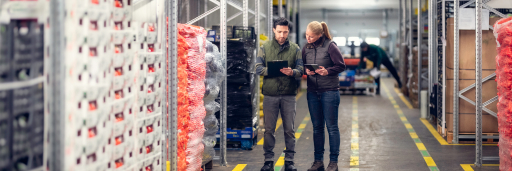
| Not all warehouses are created equally.When companies start looking for a third-party logistics (3PL) provider in Canada, many assume warehousing is simply about storing products and shipping orders. The reality is much more complex. Depending on what you are storing, the requirements for safety, compliance, training, equipment, and inventory management can vary dramatically. |
For businesses in the food, hazardous materials (hazmat), and retail sectors, choosing the right 3PL warehousing partner is about much more than square footage. It is about finding a provider with the expertise, certifications, and infrastructure needed to protect your products, your customers, and your reputation.
What Is a 3PL Warehouse?
A third-party logistics (3PL) warehouse provides transportation and logistics services, freight forwarding, shipping services, fulfillment services, cross docking, reverse logistics, and value-added work such as kitting, assembly, labeling, and custom packaging. Instead of managing these operations internally, businesses partner with a logistics company to improve efficiency, reduce costs, and gain scalability.
While many 3PL companies offer basic warehousing services, specialized industries often require much higher standards. Some providers operate as asset-based 3PLs, meaning they own their trucks and warehousing facilities, while non-asset providers coordinate services through external networks. The right service provider should offer customized solutions that match the needs of a specific business, rather than forcing every customer into the same process.
Let us look at three of the most demanding sectors: food-grade, hazmat, and retail distribution.
Food-Grade Warehousing Requires Strict Safety and Compliance Standards
Food products come with unique challenges that go far beyond inventory management.
A food-grade warehouse must maintain cleanliness, proper storage conditions, pest control protocols, and strict inventory rotation practices. Products must be handled in a way that meets regulatory requirements and prevents contamination.
Key requirements often include:
- Food-safe storage environments
- Inventory traceability and lot control
- First Expired, First Out (FEFO) inventory management
- Regular sanitation procedures
- Compliance with food safety programs and audits
- Temperature-controlled storage when required
For food manufacturers, importers, and distributors, even a small compliance issue can lead to recalls, damaged customer relationships, and significant financial loss.
This is why selecting a 3PL partner with proven food-grade experience is essential.
Hazmat Warehousing Demands Specialized Expertise
Storing hazardous materials is one of the most highly regulated areas of logistics.
Chemicals, aerosols, flammable liquids, corrosive substances, and other dangerous goods require specialized handling procedures designed to protect employees, communities, and the environment.
A qualified hazmat warehouse typically provides:
- Segregated storage areas
- Proper dangerous goods classification
- Spill containment systems
- Fire suppression equipment
- Specialized employee training
- Regulatory compliance monitoring
- Transportation of Dangerous Goods (TDG) expertise
Organizations that handle hazardous products cannot afford compliance gaps. Regulatory penalties, environmental incidents, or workplace injuries can result in lawsuits as well as severe financial and reputational damage.
Working with a 3PL provider experienced in dangerous goods storage helps reduce risk while ensuring products move safely through the supply chain. For companies shipping goods across provincial borders or into international markets, the right provider can also coordinate documentation, transportation requirements, and compliance steps that support safer movement from warehouse to destination.
Retail Distribution Is All About Speed, Accuracy, and Scalability
Retail logistics presents a completely different set of challenges.
Retailers face intense pressure to meet customer expectations, maintain inventory availability, and deliver products quickly. Seasonal fluctuations, promotional events, and changing consumer demand can create significant supply chain complexity.
For ecommerce businesses selling consumer products, retail warehousing often extends beyond storage. It may involve ecommerce fulfillment, pick and pack services, returns processing, promotional kitting, retailer compliance, and coordination with multiple shipping carriers. Many providers also support last mile delivery planning to help improve delivery times and manage shipping costs.
A retail-focused 3PL must be able to:
- Process high order volumes efficiently
- Meet retailer compliance requirements
- Manage SKU-intensive inventories
- Handle promotional displays and kitting projects
- Support omnichannel fulfillment
- Provide accurate inventory visibility
- Scale capacity during peak seasons
In today’s market, consumers expect faster delivery than ever before. Delays, inventory errors, or compliance issues can impact retailer relationships and customer satisfaction.
An experienced retail logistics partner helps businesses maintain consistency while adapting to changing demand. The right partner can also provide flexible storage options during seasonal spikes, support reliable fulfillment, and manage reverse logistics when returns become part of the customer experience.
Why Industry Experience Matters When Selecting a 3PL Partner
Many warehousing providers can store products.
Far fewer can successfully manage food-grade inventory, hazardous materials, or large-scale retail distribution while maintaining compliance, accuracy, and operational efficiency.
When evaluating 3PL warehousing companies in Canada, ask questions such as:
- What industries do they specialize in?
- Do they have experience with regulatory compliance requirements?
- What certifications and safety programs are in place?
- Can they support future growth and seasonal demand?
- What technology systems provide inventory visibility and reporting?
- How do they manage risk, quality, and customer service?
Businesses should also ask how a provider handles seamless integration with existing systems, how pricing is structured, and whether services can scale as order volume changes. In many 3PL arrangements, pricing may be modular, with separate line items for storage, handling, transportation, fulfillment, special projects, and returns. Understanding those details early makes it easier to compare proposals and evaluate overall cost effectiveness.
For companies that need more than standard storage, it is also important to understand whether the provider can support specialized services, distribution solutions, special projects, and tailored solutions for unique handling, packaging, or fulfillment requirements.
The answers can reveal whether a logistics provider is equipped to handle your specific operational requirements.
The Competitive Advantage of the Right 3PL
The right logistics partner delivers more than storage space. They become an extension of your business, helping improve service levels, optimize supply chain performance, reduce operational costs, and support long-term growth.
Whether your organization requires food-grade warehousing, hazardous materials storage, retail distribution services, ecommerce logistics, or a combination of all three, partnering with an experienced Canadian 3PL can provide the expertise and infrastructure needed to manage increasingly complex supply chains.
A reliable third-party logistics company can create cost savings by improving warehouse processes, reducing errors, consolidating transportation, and supporting more cost effective fulfillment. Many food-grade 3PL providers also use warehouse management systems (WMS) to support real time visibility, stock control, lot tracking, and inventory accuracy. For growing businesses, those processes and technologies can turn warehousing from a basic expense into an operational advantage.
As consumer expectations, regulatory requirements, and market demands continue to evolve, choosing a specialized 3PL provider that provides exceptional service and logistics solutions can help businesses remain flexible, responsive, and competitive across Canada.