
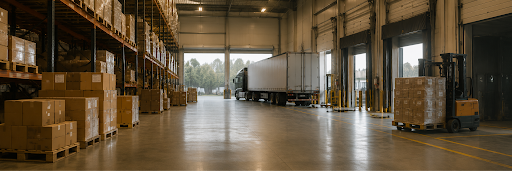
Purchasers of warehousing and transportation services are balancing cost, service, and risk, often with imperfect information and changing demand. For many businesses, the right provider acts as a strategic partner, helping buyers make better supply chain decisions over time.
Below are six common challenges we see, and how choosing the right warehousing and transportation provider helps address them.
Cost Predictability & Total Landed Cost
The challenge
Logistics costs are rarely static. While rates matter, buyers are often held accountable for budget overruns caused by:
- Unplanned accessorials and surcharges
- Volatile transportation costs and markets
- Rising storage costs
- Disconnected shipping, warehousing, and freight decisions
These variables can make true landed cost difficult to forecast, especially when serving remote areas or managing a wide distribution network across Canada.
The approach
The right logistics company begins with understanding your cost objectives, not just quoting rates. That includes:
- Transparent pricing structures and open discussions about cost drivers
- Aligning warehousing solutions and transportation decisions to reduce costs
- Sharing projected annual costs for the business profile so there are no surprises
- Considering the location of facilities, carriers, and distribution centers to support better long-term profitability
Their goal is real cost clarity by helping teams optimize decisions before small issues become expensive problems.
Reliable Transportation, Warehousing, and Quality of Service
The challenge
For some warehousing and transportation providers, “high-quality service” is often promised but inconsistently delivered. Instead, buyers frequently experience:
- Variability in day-to-day execution
- Different service levels depending on volume or market conditions
- A gap between what’s sold and what actually happens operationally
This inconsistency creates risk for buyers who are measured on reliability and customer satisfaction.
The approach
The right provider treats service quality as a discipline by:
- Ensuring the provider has the appropriate quality assurance designations
- Setting and agreeing on clear expectations for service levels and accountability
- Aligning operational teams closely with customer requirements
- Measuring performance consistently with KPI metrics and addressing gaps proactively
Quality service isn’t just about avoiding failures. It’s about delivering predictability buyers can trust. Ask your potential provider how they meet the challenges above and how their services support long-term success.
Flexibility for Changing Volumes and Short-Term Needs
The challenge
Demand rarely follows a perfect forecast. A product promotion may outperform expectations, a new customer may ramp up faster than planned, or excess inventory may create a sudden need for more storage. Buyers often need:
- Short-term or overflow warehouse space in storage facilities
- Temporary increases in transportation options and capacity
- The ability to scale without renegotiating everything
Rigid inventory management solutions can create unnecessary risks. This is especially true for manufacturers and other buyers managing raw materials, finished materials, food, or seasonal products that require careful handling.
The approach
The right provider plans for variability from the start by:
- Establishing a consistent communication structure to review business needs
- Understanding current and future requirements for space, labour, equipment, and transportation
- Responding quickly when demand shifts
- Offering practical short-term solutions without forcing long-term commitments
A connected transportation-warehousing plan gives buyers room to adapt while keeping operations stable.
Reliable Execution You Don’t Have to Manage
The challenge
When logistics fail, buyers feel it immediately through customer complaints, internal escalations, delayed shipment updates, or missed targets. Reliable execution is therefore crucial not just for hitting KPIs and mere metrics, but also for maintaining positive relationships and building trust with customers.
The approach
The right provider focuses on consistent execution and accountability by:
- Maintaining disciplined operating processes and standards
- Developing experienced teams who understand your business
- Taking ownership of exceptions instead of passing them along
- Providing timely updates when conditions change
That means fewer operational distractions and more confidence day to day.
Clear Visibility and Straightforward Communication
The challenge
Buyers need visibility into inventory, orders, and shipments, but information overload isn’t helpful. What matters is timely, relevant insight and proactive communication.
As logistics becomes increasingly automated, buyers still need clear explanations, practical resources, and responsive management.
The approach
The right provider prioritizes clarity by:
- Sharing meaningful KPIs that align with your priorities
- Providing timely updates when conditions change
- Communicating clearly and directly, not just through automated reports
- Helping buyers optimize decisions around storage, transportation, inventory, and delivery
These practices keep buyers informed, prepared, and in control.
Risk Management and Business Continuity
The challenge
Disruptions, such as labour constraints, weather events, capacity shortages, infrastructure delays, and limited carrier availability, can occur at any moment. Buyers are expected to anticipate and manage these risks, often without full visibility.
The importance of business continuity becomes even clearer when supply chain interruptions affect products that must move quickly, safely, or at scale.
The approach
The right provider reduces risk exposure by:
- Identifying risks early and discussing contingencies openly
- Offering alternative routing, capacity, or storage options when needed
- Leveraging strong operational and carrier relationships during disruptions
The result is a more resilient supply chain that can absorb unexpected changes.
A Supply Chain Partner, Not Just a Logistics Company
Choosing the right warehousing and transportation partner isn’t simply about capacity and rates. It’s about working with a team that understands your objectives, communicates openly, and helps you navigate change with confidence.
Whether you need dependable storage, efficient inventory management, smarter distribution, efficient freight movement, or support during changing demand, our team can simplify your company’s logistics. Contact us today to discuss warehousing and transportation options for your operations.